Showing posts with label cost. Show all posts

Monday, May 2, 2011

...and the results are in!


Sorry for the lack of posting lately—oddly for me, I haven't had much to say! -G- Since I was low on pot-fillers and plant-foods, I went back to the processes I knew would work and shelved (most of) the experiments awhile, and “Day fourteen: bucket ready for stage two” doesn't make for interesting posts.

But it occurred to me as I was picking lavender for a fruit salad that I had written something about that plant's rooting medium soon after its potting, with no followup. So...

This is one of the plantings where I used bokashi and shredded office paper, with no additional microbial source and an extra-long curing period during cooler weather. I tossed some exhausted dirt in the bottom of the container, filled it most of the way with the paper-bokashi mix, then dug a small nest into the paper and filled that with decent potting soil, into which I planted a typical four-inch nursery start. About an inch of soil to top. No olla pot in this planter, mostly because I didn't have one ready but also because I wasn't sure the paper would hold one stable. (A later test confirmed that assumption, though it is possible to use the side of the planter as a partial support.)

Call this a very slightly qualified success I cannot currently replicate. It's a little messier than I prefer my container gardening, especially without crockery in the bottom of the planter—a step I gave up on for good when I realized that it might prevent worms from colonizing my plantings. But the muddy deposits around the base of the planter are attractive to wandering worms, many of whom then find their way into the planter, and a larger-than-normal drip tray will retain that nutrient-rich material until it can be tossed back on top or harvested for another planting.

As well as the mess, this method looks like it might require a mid-season addition of potting mix. This isn't an insurmountable problem, but I prefer to avoid mucking about with roots between repottings. The bokashi and paper seem to be decomposing both faster and more completely than I'd anticipated, and there isn't enough soil in the planter to support the plant alone. Next time, I'll add a bit of sand or some other non-nutritive material. Natural fabrics, maybe; they decompose more slowly than paper, and plants root well in them.

Now for the good parts:

No root-burn! Most of the bokashi mixes have to be cured after mixing with potting media, which is fine for more organized gardeners but a trial for me; this material was close enough to neutral pH to be safe for immediate use, and while there was likely a bit of heating, it wasn't enough to register on my low-tech tests, no more an issue than Texas sunlight if the planter was watered adequately for the plant. (A second test suggests that you really don't want to let it dry out even halfway within the first week, though I found no troubles thereafter. I'd try it again, but I'm out of “hoarded” bokashi. For now.)

No long-term odor. There was a faint but present unpleasantness upon emptying the hoarded bokashi, as there often is when emptying a bokashi bucket left to sit awhile—which is why I always do that outside—but it wasn't noticeable an hour after the planting was finished. A soil cover or some other barrier is definitely necessary lest the material attract pests, but with that one small remediation, this seems like it could be used in any outdoor setting.

No additional fertilizer needed. Bokashi's a nice sub-surface slow-release plant food; 'nuff said.

No trash. Convert kitchen waste and junk mail into produce? Sounds great to me. And this method used only “trash” and an EM source, plus a small quantity of soil for the potting, most of that re-used. Cheap and responsible, my favorite kind of technique.

The lavender was one of two plants I potted in this mix, the other being a blood-veined sorrel that's quite stunted in appearance just now. A casual observer might decide it was was overnourished and therefore feels no need to grow—look closely and you'd see signs of my too-frequent harvesting. What can I say? I grow things so I can eat them.

The garden plan having been scuttled by last fall's too-dramatic events, I joined a CSA this year to augment my produce production. Vegetables are packed in shredded paper for transport, so I thought I'd try the same slow-cure method...but it turns out that doesn't work in warmer weather here. No bokashi hoarding in Texas heat!

Maybe in an air-conditioned office?

Definitely worth further trials.

--Until the next,

DSF

[image source: http://dittodoesit.com/2011/02/academy-awards-envelopes-designer/]

Monday, October 4, 2010

What makes a good bokashi bran?


Some posts just fall through the cracks—I don't have a good image, there's something else I'd rather do, I'm missing a bit of information I'd like to include, whatever. But just sent me a message reminding me that there's a whole small set of posts I've neglected to publish!

Oops.

I'd intended to put up a few reviews of various retail EM bokashi brans. Still mean to, I guess, though I'm not currently within reach of those files. Haven't tried all the available options yet, but the handful I've been through have been different enough to make comparisons worthwhile.

Beginning with the cost. The fact that EM bokashi costs anything is a not inconsiderable barrier to adoption. Expensive designer buckets and how-much-plus-shipping? bags of magic dust don't always seem like a reasonable alternative to current practice. So cheaper-per-unit bags get my vote over more expensive ones, of which there are a surprising number.

So do local products, assuming there's no or only very little difference in total price. (I'll pay a bit extra for the instant gratification factor, but not very much.) Not being vigilant enough to police manufacturers for sustainable practices, I'll skip the whole carbon-footprint bit for now.

As yet, I haven't chosen not to buy an inoculated bran because of its base, but I wouldn't elect to buy one with sawdust in its ingredients. Personal preference. I'm a gardener and just don't want to see sawdust clinging to my sweet potatoes at harvest. Bran composts quickly.

Speaking of preference, I'm much more inclined to purchase from a retailer who lists the ingredients—including the specific microbes in the culture together with that culture's source.

Assuming all other variables were equal, I'd buy the one packaged in a compostable container. The pictured rice-bran ones comes in a corn plastic shell that will decompose in the bokashi bucket! But, again, that's not too high on my list.

So what's up at the top, just beneath the all-important cost?

1. Moisture: Packaged bokashi bran is described as dry and shelf-stable, but it isn't always nor equally so. If I'm springing for the pre-made stuff, I want it dry! Dry enough to store some in my hiking kit, or to keep in a starter-bucket in my car for a week or two. Dry enough that it won't grow acetobacters in the bag to startle the poor unsuspecting victims new bucketers to whom I'm delivering those welcome-to-bokashi gifts. And, it goes without saying, dry enough that it won't spoil before I get a chance to use it.

2. Scent: Bokashi bran from Hawaii doesn't smell the same as bokashi bran from Texas, even if the ingredient lists are identical. Nor does bokashi from every retailer in a region smell the same. I found one retail bran unacceptably acrid, though it worked perfectly well and the less-vinegary character might make it a better choice for some. As well, there's a difference in scent between wheat bran and rice bran, though I don't much care which is used. Not sure how to quantify that, but it's worth mentioning, if only so other people know the variance exists.

3. Speed to success: Fresh bokashi bran starts to work faster than dried, but that's a matter of hours, not days. Bokashi that's been improperly stored (frozen or exposed to air, I guess) takes much longer to work, and may require more inoculant as well. The retail bran that I wasn't sure was working until the second day isn't one I'll be buying again even though it did successfully ferment a bucket. Quick evidence of success seems like a good thing--though not at the expense of shelf-life. Of course, lasting evidence of success is kind of necessary, too; I rate all the EM items on how well they can handle small volumes of things the retailers tell you not to add; how long it takes the deodorizing microbes to conquer strong aromas; etc.

4. Directions: now and then I'll buy a bag of bran for someone else, not always for a bokashi bucket. Folks with cats willing to use compostable litters can mix EM bokashi bran into the box, and it's useful in the dog-yard as well. I don't insist that the packaging say that, but it really should say something about use, considering how unfamiliar most people are with the product. EM bokashi bran is not a term that can stand without definition, not yet. Ideally, the package lists how much kitchen waste it can be used to process, in gallons. And the fact that something has to be done to that processed/pickled waste afterward.

5. Add-ins: I haven't decided how I feel about these. Some of the EM bokashi retailers have extended their brands, so they have different brans for different situations. Minerals in which a region is known to be deficient; seaweed for agricultural use; etc. At the moment, I don't buy them, so can't rate them, but they, too, belong on the list of criteria to consider. For later, since I don't seem to be ending this project any time soon. -G- At some point, I'll probably try the EM mix with extra rhodobacters. I would not buy a bokashi bran with added salt (not even sea salt), refined sugar, synthetics or animal products--but I haven't yet seen any of those anyway.

My perfect packaged EM bokashi bran? Made locally, and widely available on store shelves as well as online; comes packaged dry in a waterproof compostable container; contains only EM-1 (or the extra-rhodobacters one), with molasses, rain-, spring- or well-water, bran, and maybe a responsibly sourced mineral or two; costs no more than $5/bucket-worth in today's dollars; has clear instructions including the fact that bokashi is not a complete composting solution!

This isn't a tall order. Several of the various retailer products I've tried have come close. They all fail on that disclaimer; only two have been really dry so far (plus one retailer where the first bag was dry but the second wasn't); and few are as forthcoming about ingredients as I would like, though the retailers are generally pretty willing to answer questions.

It's still a relatively new industry, so I figure one of these days someone'll score perfectly. At which point, I may reconsider my usual practice of making my own EM and IMO bokashi brans, though probably not. But I will certainly celebrate by buying a few bags to keep on hand!

DSF

Monday, April 5, 2010

Living Lettuce, meet Zombie Cress


I can still remember the first time I saw a "living lettuce" for sale at a grocery store. I thought it was the coolest thing there, and wanted my mother to buy it; she thought it was five times the price of any other head of lettuce, and declined. If I wanted to play with salad leaves, she said, I should go talk to my grandmother, who would help me grow some of my own.

Oddly, I don't remember whether I actually did; my mind's eye offers peas and mint and potatoes and a kiwi, but no kid-sized lettuce garden. Ah, well; I've grown a great deal of it over the years. But I'm still a little intrigued by the gimmicky-but-definsible living lettuce in its sturdy clear plastic casing. For many people, this is the only way they'll ever taste a freshly harvested lettuce leaf! One of these days, I really am going to buy one for myself, if only to compare the taste to my own aquaponically grown or more traditional lettuce.

More recently, I've been seeing living basil, another hydroponically grown item sold with its roots and a bit of nutrient fluid; these plants come in plastic bags that always remind me of buying pet fish, and like the living lettuce they have instructions for extending the viability of the crop. I found myself tempted by those, too; particularly if you're only using a leaf at a time, it might even make economic sense. (Assuming you can't grow your own.)

But the irrestistible item turned out to be some hydroponically grown upland cress from my local Sun Harvest. With some crops, you can't always tell if they were hydro or not just by looking, like tomatoes on the vine. But the cress was sold in the same square blocks it was grown in, dense root-pack yet intact. Sadly, the roots hadn't been kept wetted, but they hadn't been on display for long enough to dry, so I decided to buy a square.

Well, two, actually. Ate the first one, had to go back. What? I like cresses!

Cress-block in hand, I hurried home to get the poor roots into some water. My kitchen having suffered a recent outbreak of fruit flies, I wanted something a bit more substantial than a glass of water or a vase, so went with my one and only retail self-watering pot, a cute little two-part container with a glazed exterior pot and unglazed insert, reservoir space between. And for added security, I packed a bit of Spanish moss around the cress stems before setting the whole on a counter within view but out of the way. (Outdoors only long enough to take a picture.)

I've been nibbling the odd leaf now and then, but the bulk of the block's still viable. The leaves that were bruised during transport are long gone, of course, as are the ones injured by the rubber band. Some just never perked up again, too long away from their fluid, I guess. As well, a couple have yellowed as if from nitrogen deficiency--these are not still in their hydroponic set-up, after all, but only in water to keep them from wilting. No matter the appearance of new lobes on the stems, this is really not a living, growing, eating, increasing, plant, just not yet quite dead, and still crisp and yummy.

Folks keep standard post-harvest leaf lettuce alive this way, too. It's not the same as the living lettuce, but again, keeps the leaves usable for longer--a lot longer than just tossing the bag in the fridge. For folks who don't garden or like me can't grow enough leafy produce, don't care to hit the grocer every few days, and/or are more likely to use a leaf if it's right in front of them, this might well be worth the small change in habit it takes: less waste, better value for dollars spent, and all the rest.

For me, I'm thinking it's time to eat the rest of that cress. Or, maybe not quite all of it; I could divert a small section to one of my tiny vermiponics experiments, just to see. A couple of worms, some Spanish moss, a little bokashi juice...

Excuse me, I'm off to go play with my food. -G-

DSF

Wednesday, March 17, 2010

There’s a hole in my bucket wallet


Blew the garden budget again, though not by so much as you might suppose; aside from a pack of tomato seedlings I couldn’t resist, all this year’s new stuff has been or will be started from seed, much of it bought locally. Or produced and collected here on-site, like the shepherd’s purse, hyacinth vine, and amaranth. New purchases included a few different sorts of tomatoes—not that I expect them all to thrive, but so I can be sure of having any, and to try the different leaves—a couple of edible curiosities (eggplants shaped like miniature pumpkins? I couldn’t resist!), and a bunch of things the standard American grocery-shopper has never heard of, plus one or two sometimes considered weeds.

Sadly, I don’t think this is the year I’ll be growing enough produce to skip the greengrocers entirely (small spaces=smallish yields, though bokashi’s helping), so I’ve chosen as usual to focus on things I can’t get there or that I can’t afford to get there.

A few durable goods went into the virtual shopping cart, including a pressure sprayer to make bokashi juice application easier. Plus, I bought a few more bags of dirt—given the quality, I don’t think it merits the label soil—though not for immediate use. I am planning to refill the planter tower and let the feral worm colony play awhile, and to set up a test in temporary vermicomposting if I can talk a particular friend into loaning me the space. Also picked up, from the same retailer and brand as the dirt, some “humus” (those quotes denoting doubt) for a few different tests.

Can’t quite bring myself to admit the total here; more than I meant to spend, but less than the season cost of a single share in a CSA in this area. And unlike with the CSA, there’s no risk I’ll end up with a box full of things I don’t eat.

It could have been much worse. High-quality chem-free compost typically makes up a fair percentage of my total cost; so far this year, I’ve bought not so much as a single quart. Between bokashi and Verne (and George), there’s been no need—though that may change once the raised beds are in. Too, I usually end up buying eighty or so quarts of potting soil every spring, to replace the worst of the potted stuff and top off the permanent planters, and until this year have always bought the best I can afford, since I know how important it is. But thanks to last fall’s cheap-as-dirt test, that hasn’t been necessary either.

So wherefore the post-shopping-spree regret? Well, there were a lot of seeds. And though the local drought is officially over, that’s more likely a temporary condition than not, so I’m determined to fit out all my containers with some form of irrigation, preferably primary though I’ll take supplementary if that’s all I can get. Which in many cases equals additional cost, for clay pots to plant with the transplants, or hoses to connect to an external reservoir, or more nested-bucket sets and wicks and hollow pipes and things to make SIPs.

On the other side of the balance sheet, Verne has more than proved himself worth the one-time investment. I don’t think I’ll ever bother with an indoor wormery again, and neither are worms my choice for a primary landfill-diversion scenario, but outdoors, he’s doing his part to maintain soil health in the towers and planters, keeping me from having to replace soil as often (or at all? Too soon to say), and since he’s enthusiastic about his business, there’s no need for me to buy any vermicompost or vermicompost tea this season, either. Or, obviously, worms.

The bokashi’s worth the cost, too. Naturally –G–. Though EM-1 and molasses (and bran, for the standard recipe) are repeated costs, it’s cheaper to buy them than finished composts, fertilizers, and “instant” plant foods. Not to mention the non-monetary benefits.

One of these seasons, I’ll stick to my budget. Really. Maybe if I just start with a higher number…? Oh, that sounds like a bad idea!

DSF

[image from Botanical Interests, which is the right company, though mine were purchased from a local retailer]

Saturday, February 6, 2010

Rigged to Succeed


Last fall, I bought the cheapest potting soil available to see how much of an improvement bokashi could make. Some of that soil, layered with bokashi, was put to as immediate a use as feasible; a few gallons of it I set aside to rest until spring.

The placement of those resting planters may have presented an unfair advantage. Though I wasn’t intending to cheat! It’s just that I have so little space (especially since I started measuring my life by the bucket -G-), and the matched set of five filled one-gallon planters seemed so very suited to stacking, so I stacked the things. And where else would a stack of planters go but next to the worm towers?

The first of my seed orders arrived last week, and there was a break in the weather today—must be time for sowing! Or at least mixing a seedling soil. Wandered out to bucketville intent upon collecting a bit of vermicompost (not pure vermicast, as that’s too strong for seedlings), maybe a bit of composted bokashi, and some potting soil. Figured I might add some Spanish moss for airflow, sand for certain crops, all the usual, but first the basic dirt-and-nutrients.

Verne, Sexton, and the third planter tower I keep pretending is only temporary and have thus not named were all overdue for feeding and ready for a harvest, so I collected some finished vermicompost (and such vermicast as had precipitated down into the reservoir layer). Reaching for planters gets to be kind of automatic by the time you’ve deconstructed three towers, so I’m not sure the difference in design really registered, though I did note the absence of a plant at the tower-top. A clay saucer?

Oh, right, I thought, this is the spring soil test. Well, it’s not really spring, but last-frost’s not too far off, let’s see what we’ve got. So I tipped the saucer off and hauled the top planter down to take a look. What I saw was yet more red wigglers living up to their name. Not, mind, so many as in the established worm towers, but probably enough to start a new wormery with. And I saw the same in every planter in the stack. Without the trivets and internal bracing I installed in the tower wormeries, too—apparently, composting worms are far less sensitive to pressure than I’d assumed. The soil was fairly wet, but responded easily to gentle forking, the ideal cake-crumb texture so often cited and so rarely seen, at least by me. Some volume reduction had occurred, as the bokashi broke down and the worms ate and the storm-waters flushed loose bits away, but I figure I’ve got about four gallons of incredible soil ready for the planting.

Can’t say just now how it compares to high-quality retail soil, as I haven’t got any of that. I did plan to buy some, but...why? My last batch of in-house mix from the Natural Gardener didn’t look as healthy as this! Feels like I’d just be throwing money away.

Not buying any worms this year, either. But I might be forced to invest in a few more seeds...

It never ends, does it?

Happy spring is about to spring,

DSF

Wednesday, February 3, 2010

The Add-A-Bag Garden?


We're enduring a small spate of seasonal weather here in Austin, so I can't do anything about this idea right now except record it--but I've just found my next post-bucket experiment, and I can't wait! Hardly revolutionary, nothing more than a small tweak, really, but if it works...

1) Choose a compostable bag* suitably sized for a determined garden space.

If you're a small-space gardener, that may well be a doubled grocery bag; folks with room for larger raised beds could use leaf and lawn bags or those canvas sacks used for coffee beans and other staples. Not sure about compostable plastics, but it might be worth a try.

2) Combine well-cured bokashi, dried leaves or shredded paper, and soil or a soil-based potting mix in the bag. Close and set in place. (If using a grocery bag, roll top down, then wrap bag with twine and tie, and placed with the rolled side down.) No need to clear the ground first, though if your greenery is especially vigorous, a layer of cardboard or several newspapers might not be a bad idea.

3) Secure and let sit the requisite two weeks? (There's a testable variable! But, sure, why not. Allows for starting some seedlings or a trip to the nursery.) Then,

4) Using a spade or shears, cut V-shaped holes into the top of the bag. Into each hole, insert a spadeful of best-quality potting mix and a transplant. Olla pot(s), if using, should be placed now, too. The garden bag having been planted, it should be treated as appropriate for the region and conditions. And finally,

5) Repeat when your next bucket's cured.

It's the Add-a-Bead model of gardening: Find a spot, plunk down a bag, go on your merry way. Come back in a fortnight to plant the bag-in-place and set another beside it. Continue until all the world's a garden. ...yeah, okay, maybe not. But every time I help build a raised bed, I'm surprised at how much dirt it takes. This way, you could start with such soil as you had and acquire more as the situation permits.


Will this work? No reason why not, though there are several variables to be tested. Is it worth collecting paper bags if you're not a slightly obsessed bokashi-er? I think so, though, again, this is as yet only a rainy-dayweek's dream.

Like planter-finishing, this does require messing around with the cured bokashi, though only once. (Oh, joy: another test! Using disposable liners here.) Still, it's not like dumping a bucket into a bag of leaves is all that difficult. Bags do mean less time-in-sight than with planter-finishing, and using the bag as a planter means less mucking about with soils, too. It's altogether a neat--pun intended--solution to the eternal question of post-bucket protocols.

With free or repurposed bags, plus dried leaves and shredded paper, this can greatly reduce the expense of creating a raised bed, and allow for that cost, as well as the physical labor, to be spread out over time. Not to mention keeping that carbon-source out of the landfill where it does no one any good at all. (Hey, it's phone book season again! Home delivery of entirely useless but easily compostable pages. Yippee?)

How much dirt to add? Well, ideally there'd be at least three inches of soil on what will be the top of the bag when it's placed--once you've got that, then for the rest, I'd probably start with my usual one cup per half-gallon of bokashi, plus an additional half-gallon of dried leaves or quart of shredded paper. I've found that to work quite well in producing slow composts and worm-food. More dirt won't hurt a thing, it's just the most expensive ingredient in that mix, so I tend to ration it. Put it up top, where it'll do the most good, and let the organics break down below. Though there are limits; I seem to recall the lasagne garden people citing six inches as the maximum between soil layers, and while this wouldn't be a pure compost layer, that's not an unreasonable place to start.

Not that it's an issue with grocery bags, but there's always the chance someone will fall for my reverse fence-painting line. "Hey, you know what'd be fun? I could come install a raised-bed garden on your property?" -G-

And, oh!, think of what a demonstration garden this might make. If it works, it's simple enough for kindergarten classes. Step right up and take a look at The Clean Your Plate Garden. So easy, even five-year-olds can do it! How's that for a pitch?

DSF


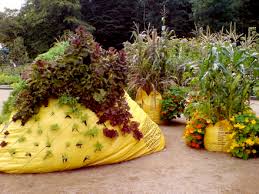
*No, the photo's not of a compostable bag. That's a "construction debris bag," as featured in a story a couple of years back on TreeHugger and GroovyGreen. And if I can get my hands on something in that line, or a more common landscape cloth bag, I'll certainly extend the test.

Sunday, October 25, 2009

Poor dirt, rich harvest


I like the idea of subsurface fertilizers; it seems right to me, putting the plant food where the roots can grow down into it. That’s the appeal of planter-finished bokashi: after the bucket, layer the fermented matter into soil, et voila! Though this is not always the right solution for me--it requires being organized enough to gather relatively large volumes of soil, cured bokashi, and empty planters together for assembly; there’s that two-week resting period before planting; and it doesn’t use enough bokashi for my needs, not without many more planters than I have room to keep. Only one third of a planter’s volume can be bokashi with this method. And what does one do about the permanent planters, where soil and roots have been placed long since? So I compost much of my bokashi, or finish it in some other fashion. Still, where I can planter-finish it, I do, as that’s some impressively nutritious ready-to-sow soil once it’s ready! Even where the soil wasn’t much to speak of starting out.

Over the years I’ve been container gardening, I’ve bought soil of every quality from appalling to magnificent, but even the best eventually grows tired, separated from the soil web that would refresh it in its place of origin. Compost helps, of course, and vermicompost even more, but those natural amendments are not exactly cheap if one has to purchase them over and over (and over!) again.

I have no need to buy compost these days. And with Verne and Co. cheerfully digesting plantersful of precomposted leafy bokashi mix, I no longer have to carefully ration vermicompost so as to have enough for every plant in my garden. I don’t even necessarily have to apply the stuff, as free-range wriggles will find their way into outdoor planters where bokashi has been added and do their thing on-site. After a year of this, the garden is demonstrably healthier than before, with strong new growth and incredible yields. While it is still possible to tell the the very worst of my previous (clay) pot-soils, most of my planters now contain rich mixes comparable to the very best organic retail products I can afford, all dark and springy and largely differentiated by amendment for particular growing needs. It’s hard to believe how much of this stuff was barely able to support plant life a bare year ago, or to remember what a victory I considered a few paltry heads of lettuce in the days before bokashi...

So the other day, I hit a local store for the cheapest available bagged potting soil--$2.50 for 40 quarts--for another in my ongoing series of experiments. This is visibly poor soil, lots of sharp sand in a suspiciously dark and lumpy base (either non-local or amended with treated municipal sludge, or perhaps both). I’ll be planter-finishing this soil with bokashi in both indoor and outdoor settings, and growing leafy vegetables or herbs in it; suppose I’ll try a few lettuce seeds or something in the unamended soil by way of confirmation that this stuff is as poor as it seems, but otherwise, the comparison will be between this soil layered with bokashi and the potting mixes I already have, which have all been heavily inoculated with microbes and nearly saturated with plant-accessible nutrients by this point.

I expect the more amended soil to perform better, but honestly not by too much; microbes live quickly, after all, and the major difference I’ve seen in short-term performance between bokashi-only or vermicompost is in germination (long term observations are ongoing). There is a better than even chance that the produce will be slightly less healthful than that grown in my organically sourced soils, but I’m in a transitional sort of mood today, so am choosing not to worry about it much. It should still be far better than anything bought from a conventional grocery store, that’s been losing nutrients during shipping and display...and cheaper, too! Both in terms of resources used per calorie/serving, and to my budget; the planters (buckets) were all free, bokashi costs me at most $0.50 a bucket (one dollar a week figure for standard EM bokashi bran recipe and accessories), and one bag of this cheap potting soil should be enough for two and a half to three large planters. So call it $1.00 per planter, each planter about equivalent to one “square foot” garden sub-plot, usable for many, many years as bokashi and compost will serve to renew the organic materials plants remove from the soil. Leaving me only the cost of seeds or transplants, if I don’t propagate my own from gathered or gifted sources.

My elderly relatives used to talk about “poor dirt farmers,” but somehow, I don’t think this is what they meant. Then again.

DSF

Wednesday, August 19, 2009

Tales from the Bucket: Dark-Roast EM


I’ve been playing with used coffee grounds (UCG) in place of bran. Not the stuff I generate--I do drink a fair amount of coffee, but not that much, I don’t think--but coffeehouses hand the stuff out if you ask, and I frequent any number of the joints.

The last batch of caffeinated EM bokashi bran I made was, by my standards, very large: 40 cups of UCG, plus AEM and molasses and a pint or so of water. As UCG is damp-to-wet upon receipt, you need less water than in the basic recipe; other than that, and fishing out any filters (or teabags, depending on the coffeehouse), no changes need be made to the fermentation. This does require very fresh UCG, however; undesirable microbes will spoil the grounds in short order.

Takes about the same length of time to ferment UCG as wheat bran, completion judged by presence of mycelia, scent, and pH. It's tempting to dry some for use as a mulch--it looks right!--but that test shall wait until early spring, when heating the soil layer might not be altogether a bad thing. As with any EM source, it encourages hot-composting reactions when added to high-carbon (brown) materials. In contact with the scattered leaves atop my soil, and bits of same mixed in, I imagine it might burn roots in more than one sense, and my plants are already hot enough, thanks.

In a bucket, the EM+UCG encourages fermentation. Just like the bran-based stuff. I’m generous with my microbes, but no more generous with coffee-based than otherwise, and it works just as well in most situations, better in some (though not, I imagine, in a litter box or cage!).

As for the smell, any undried EM bokashi bran has a characteristic aroma. The coffee’s is stronger than the wheat bran’s, but my bokashi buckets have fair quantities of coffee grounds in them regardless, so there’s no real difference after the initial bucket-seeding. And if the smell of used coffee grounds were going to bother me, it likely would have long before now.

The only place I run into problems with UCG-based EM bokashi bran is while drying--solar drying seems so practical here in Austin, but Repulsive’s adult offspring are drawn to the scent of EM anyway, and they adore UCG, and have been known to penetrate my solar dryer to reach the stuff. Yecch! Some folks use their cars as enclosed solar dryers, but I have the same problem with that as I do with oven drying: I’m averse to filling my kitchen with odd odors, so oven-drying sweet-pickled coffee’s just not happening.

Oven-drying wheat-bran-based EM bokashi bran I’ve done, and it smells more like bran muffins than otherwise, so I can handle that. (Fairly strong undertone of kombucha during the first minutes, but not intolerable when the weather allows for open windows.) For the most part, I make my EM bokashi bran in small enough batches to use fresh, which is one less step and takes far less space, but that may not be practical for all people in all situations. In this case, I walked into a Starbucks and, on seeing their Grounds for the Garden basket empty, asked if they had any UCG. They gave me more than a bucket’s worth, double-bagged and so heavy I wished it had wheels. So I figured I might as well make a large batch. For one particular use, it wouldn’t matter if Repulsive got into it while drying--

But that’s another post, I think.

UCG as a carrier may not be the single greenest or most frugal choice, depending on your situation (transportation miles, unknown source of mixed beans, the temptation to wallet and waistline engendered by entering a coffeeshop in the first place...) But while wheat bran is cheap, free is often better, and UCG is a waste item anyway, having already served its purpose. So I thought it was worth trying.

Anyone know if songbirds are sensitive to caffeine? I know they can get drunk, at which point they fly into windows and lampposts and things. Do I have to make decaf coffee bran?

DSF

-G-

Monday, July 6, 2009

Frugal Bokashi


When I did the numbers before starting this project, I figured an initial $30 investment should cover my first six months of bokashi, $5 a month to see if bucket fermentation was suited to my particular needs. No retail-priced bokashi bucket in that budget (though I am curious about the EM-impregnated plastic ones), not even packaged dry EM bokashi bran, just a bottle of EM-1, molasses, and bran, plus some scrounged buckets. The cheapest entry-point I could see. Why six months? Because I’d read that the bottled culture would lose efficiency after that point, so I’d have to restock. Or not, if it turned out bokashi wasn’t for me.

It’s approaching the one-year mark, and I decided to revisit those numbers. How much did a year of bare-bones branded EM bokashi cost me?

A dollar a week.


Actually, a bit less. $50 for the first year, counting a few durable items. I decided that spigots are absolutely necessary for me—I’m lazy, and far less inclined to remove the inner bucket from the reservoir than I am to just turn the tap—and bought as well a couple of potato mashers and a pail opener to complete my basic bokashi kit. That last item isn’t necessary with my favorite repurposed kitty litter containers or the two-gallon plastic barrel with the screw-on lid, but for the food buckets, it’s a convenience well worth the $4 it cost.

In all, I spent less than $40 on the actual inoculant/carrier/food. And next year, that number may go down further still. A smaller bottle of EM-1 would only be cheaper if I could find one locally, as shipping liquids is seldom really cheap (to date, I’ve only found one place in town where I can buy any EM, Whole Foods). But “activating” EM stretches a bottle in terms of both quantity and longevity such that one bottle a year is reasonable, and I don’t really need a whole liter just for me. Nor would I if I were mixing bran for half a dozen households every month! As I’ve had some success with non-bran carriers, I’ll keep playing with those, so I may well buy less wheat bran, but if/when I do decide to buy any, I’m placing a small-scale bulk order for that and for the molasses as well.

The required repeated expense is a common objection when bokashi comes up in discussion. And home-cultured IMO is a valid alternative--there are tons of recipes out there, and while my own experience has so far been mixed, lots of folks swear by their non-branded silo bucket inoculants. But that annual @ $40 expense is actually saving me money. Forget about trash fees, it’s the commercial compost I no longer have to buy! But there is also the lesser expense on trash bags (volume and frequency), less use of chlorine bleach (cleaning, washing towels and dish cloths, deodorizing the trash bins) and non-chlorine bleach (laundry).

And my happier plants are producing more even in the drought and heat...

DSF

Thursday, September 25, 2008

Baby Batches of Bokashi Bran

Making EM bokashi bran a quart at a time

The EM America recipe for EM bokashi bran produces vast heaping quantities of the stuff, and requires fifty pounds of wheat bran!!! Even the smaller retailer-provided instructions begin with eight or ten pounds of bran. Bran takes up a fair amount of space for its weight: At seven plus cups per pound of bran, ten pounds is something like five gallons—which is a larger volume than my trash can, apartment-dweller that I am. And that’s before you consider mixing space or the way bran expands as it absorbs fluid.

It is, however, perfectly possible to make EM bokashi bran without first clearing enough space to raise a barn. (Or even a garden shed. -G-)

My wheat bran, I think I mentioned, came from the bulk section at Sun Harvest. $0.69/lb. list price. That’s a much better deal than the small packages in the cereal aisle, at $2.19/10 oz., and even if you’re only fermenting occasional small buckets, you might as well make at least a pound of EM bokashi bran at a time.

Why? This is why I write about “practical minimum volumes” instead of simply minimums: sometimes, while smaller is possible, it doesn’t make much sense. You could make EM bokashi bran a pint at a time, but why bother? It takes the same amount of time and effort. Cost? Bran is cheap! And bokashi bucket fermentation is far more likely to be successful if you’re generous, even profligate, with your EM bokashi bran.

My current bucket is 3.5 gallons. It’s just about half full, and there’s already more than a cup of EM bokashi bran in there—more than recommended, but not by much. If you only have a pint of EM bokashi bran on hand, you may be reluctant to add a scoop for luck. To toss in some more because those leftovers had cream sauce. To pre-apply in a holding bucket...

By all means, go ahead and ferment EM bokashi bran in smaller containers if you can’t spare a big bucket for the month or haven’t anywhere to put one; but you might as well mix up as large a batch as you’re likely to need. The make-at-home instructions include drying the post-ferment bran for storage; assuming you have the space for that, you could make enough EM bokashi bran for the year, all at once.

Me, I’m not so into the drying, and it’s not actually required if the EM bokashi bran will be used soon. Sources differ about just how long the undried product can be held without spoiling or losing effectiveness, and I’ll post about it if/when I manage to spoil some, but it won’t be a baby batch that happens to! One pound of EM bokashi bran at a time is right for my needs: it’s enough for at least two apartment-sized buckets, can be mixed up in the kitchen in a single container, without fuss or any need for odd utensils, and gets used quickly enough that there’s no need to worry about drying it.


To make one baby batch of EM bokashi bran:

Mix 1 tablespoon molasses into

1 cup warm water. When thoroughly blended, add

1 tablespoon EM-1 inoculant fluid.

Pour into 1 pound wheat bran or other inert carrier and mix well. Seal container and set aside three to four weeks before using; ready when coated with an even layer of white mycelium. DO NOT OPEN TO CHECK ON EM BOKASHI BRAN until at least two weeks have passed (warm season in zone 8b, add time for colder seasons/climes).

*Note: for my bulk bran, 1 pound = 7.2 cups dry. I’m not that precise, seven to seven and a quarter cups works just fine. Mix it in a container that looks about a third again too large for the dry bran, as it will expand as it absorbs water. (One of those plastic 34.5 oz coffee canisters is pretty much ideal.)

Thanks to Scott I, who, in the comment section of someone else’s blog-post on bokashi, was kind enough to post an apartment-sized recipe conversion.

Saturday, September 6, 2008

"a hole in the ground your money goes in?"


...no, wait, that’s inground pools, not compost trenches. Sorry. Long post coming up, broken into sections, but it’s a topic that comes up a lot in the forums:


The Cost of Doing Business Bokashi


Buckets weren’t a problem. Food waste I had—that’s what got me started on this!—but in order to start bokashi fermentation, I first had to have a supply of EM. A one-liter bottle cost me $20 at Whole Foods Market.

It might have been cheaper to purchase a small bottle online, but not by much after shipping, and besides, I didn’t want to wait. Whole Foods is just up the road from me, and since I shop there now and then, it didn’t even take an extra trip.

So I had the bottle in hand. What now? Directions for using bokashi buckets all begin with EM bokashi bran, not the liquid inoculant. But liquid EM is sometimes applied for large-scale composting... While it might not be cost-effective as a general practice, I saw no reason not to start my first bucket with EM inoculant straight from the bottle, plus a little dry matter to absorb the moisture.

It worked. (1) So the total cost of getting started was a bit of time to set up an airtight container with proper drainage (from materials I had around) plus that bottle. $20.

Much less than I’d expected to spend. A lot of the non-retail, consumer-generated text I’d read about bokashi mentioned the expense—repeated expense, lifetime expense, relatively high expense. That now-and-later expenditure seems to be the second greatest hurdle to acceptance in this country. Also, really contrary to the ideal of composting, all that consumism! A single $20 bottle is one thing, an initial investment as it were. But how often would it have to be repeated, or additional items purchased?

How much $$$ does it cost to bokashi?

That depends. Are you buying EM bokashi bran, or making your own from liquid EM inoculant?

If a two lb. bag of EM bokashi bran is sufficient to handle two to four five-gallon buckets worth of mixed kitchen waste and costs $25, (2) then the cost per five-gallon bucket is @ $6 - $12. (Of course, the end product of a bokashi bucket still requires handling in some form before it can be used, so those figures may yet increase depending on your post-bucket solution.) If you fill one bucket per month, which seems to be the average bokashi experience, and you’re generous enough with the EM bokashi bran to be certain even the leftover fast food will ferment successfully, it’d be $12/month.

Buying a bottle of EM inoculant and making EM bokashi bran is cheaper than purchasing it, but there are additional costs beyond the EM itself:

Organic blackstrap molasses or feed-grade molasses
Wheat bran or other inert carrier
(optional other ingredients)
(water)

[Pause for a necessary definition: AEM] AEM—Activated EM—is made by “feeding” EM inoculant with molasses and water, and optionally a few other things depending on the recipe and intended use. It should be used within a month, and can be used to make EM bokashi bran, possibly even with a shorter overall time-to-readiness than beginning with EM straight from the bottle. [We now return you to your regularly scheduled...]


Being an impatient sort, I started a gallon of AEM on the same day I started my first bucket of bokashi, using molasses I would have bought anyway, simply to have on hand—but for purposes of accounting, I paid $3.50 for that bottle, so $23.50 total. This AEM was intended to be the base for my home-made EM bokashi bran, as well as to give me some extra for various tests.

Since that first straight-EM bucket worked, I started the next with AEM, using about a tablespoon of liquid instead of the 15 mL bran recommended per inch or instance of waste added to a bucket, and tossing in the odd handful of shredded newspaper and dry leaves by way of moisture correction. So far, it’s been working fine, though it’s not something I’d really recommend in lieu of EM bokashi bran, which is simpler and can be dried for long-term storage.

Having said that, I suppose it could be done, if you had access to large quantities of cross-shredded newspaper or something similar, or you didn’t mind draining food wastes prior to bucketing. You’d need to buy a new bottle of EM-1 when it lost effectiveness, six months or so down the road, but until then: Total cost = recycled airtight containers, dry matter, water, and > $25.

Me, I’d be happier with EM bokashi bran; the simpler the process is, the more likely it is that I’ll keep up with it, make it a habit, and maybe even get other people started on it. “Toss a handful of magic dust on top” is simple. Easy. And easy’s worth at least a few cents to me. Not retail kit-prices, mind, nor even repeated bag o’ bran purchases, but a few cents beyond that bottle of EM inoculant.

#
EM Bokashi Bran
The basic choices are:
a) buy commercial EM bokashi bran for immediate and continued use
In which case there’s no need for those liquid ingredients, but you’ll be placing orders from now until you decide to stop doing bokashi


b) buy commercial EM bokashi bran for immediate use, plus EM incolant and additional ingredients to make EM bokashi bran for continued use


Initially the most expensive option but perhaps the most reasonable, especially for the beginning bokashier. EM bokashi bran was designed for the purpose, and is the most reliably successful means of producing fermentation rather than putrefaction within the bucket.


c) buy EM inoculant fluid and additional ingredients to make EM bokashi bran. And use liquid in the interim: Begin by making AEM; use EM + dry matter only until AEM is ready, then make EM bokashi bran; and use AEM + dry matter while waiting for EM bokashi bran to ripen.


The cheapest bran option, and therefore my chosen solution. At least for now. -G-


#


What does it cost to make EM bokashi bran at home?


Again, prices are dependent upon distributors, volumes, etc., and you might be able to acquire some materials for free. Sawdust is sometimes referenced as a substitute for wheat or rice bran, and though I have no ready source for that [curses!], the city does periodically give away free wood chips as mulch—perhaps they might be persuaded to toss in a few buckets of sawdust at the same time?


Are there other locally available alternatives I might use? Bran, rice hulls, all the options I’ve seen so far are dry, inert, consistently sized (naturally or after processing) and small enough not to hold air pockets in the bucket. High in carbon. Other requirements? Because right now, I’m thinking dry leaves run through a shredder! Or a food processor, seeing as I actually have one of those...and it’s not as if I’d need great quantities of the stuff. Hmm. Might check into that.


But for now, I’m using wheat bran, ordered through a local grocery store, since it seemed more efficient than scooping out pounds and pounds of the stuff from the bulk section. The listed price was $0.69/lb, and ten pounds of wheat bran, depending on particle size, will make something in the neighborhood of five large bags of EM bokashi bran—which is almost twice enough to get an average bokashi-ing household to the six month mark.


Why six months? Because that’s when the bottle of EM-1 would begin to lose efficiency, so no matter what option I chose, I’d be looking at a possible additional outlay at that point.


Ten pounds of bran brings my total EM investment just above $30. (Spigots, sieves, and stopcocks are all optional, hence a different category and a different post!) So call it $5.00/month –for enough supplies to ferment the kitchen waste of a four-person household, plus two starter-packs to give as-yet-unsuspecting victims friends and neighbors.


And landlords! Maybe I can get mine to underwrite my bucket costs—since the city’s about to raise its trash fees, this might be a good time to make the pitch. -G-


If I were making absurd-in-context quantities of EM bokashi bran, the per-unit price would, of course, be even lower. My numbers don’t take economies of scale into account because I’m focused on my own needs. I’m looking for the lowest-cost, highest-reward options suitable for my particular circumstances: urban Texas apartment-dweller, container gardener, limited access to living soil and limited space. Unlimited curiosity!


DSF


(1) Turns out that success was less assured than I’d assumed—where EM has been improperly treated during storage/shipping, it may not activate quickly enough to outrun putrefaction if used straight. Also, even properly handled liquid EM inoculant may be initially slower in its effects than desired. I now make AEM first, for all applications.


(2) Non-random figures, though not universally applicable. Price varies by distributor and location, but this is what a 2.2 lb. bag would have cost me, with tax and shipping. Averages from retail and customer-generated text. In-bucket usage depends on environment and type of matter bucketed among other variables.


(3) Yes, I’ll be testing smaller batches for practical minimum volumes again. The giant economy size isn’t a good option if you have to rent it a storage locker!